
Read the selected meal first
The settlements diary explains that a meal provides its efficiency benefit when all of its ingredients are available. Start with the actual recipe selected for the settlement, rather than with a general impression that the region contains enough farming. The missing requirement may belong to a different ingredient from the product you have been watching, making the recipe a more precise starting point than a county-wide view of food production.
Write down the ingredients you are checking and identify where each one is meant to come from. This is a diagnostic aid, not an additional game rule or a claim that every meal has the same number of inputs. It keeps a working producer from distracting you from another part of the recipe that has not yet been established or is not reaching the consumer.
Separate absent ingredients from absent deliveries
A product that is not being produced and a product that exists elsewhere but has not arrived create different supply questions. In the first case, follow the ingredient back to the producer expected to provide it and inspect that production relationship. In the second, keep the producer's stock and the receiving settlement separate while you investigate the connection between them, because availability at the source does not establish availability at the consumer.
Avoid responding to both situations by placing another unrelated food building. That can make the county busier without explaining why the selected recipe remains unsupported. The production chains guide follows the relationship between inputs, producers and consumers, giving you a way to keep the ingredient's identity visible while you decide whether production or delivery deserves the next check.
Check road-connected distribution inside a region
The updated FAQ describes distribution between connected settlements after a food recipe is selected. For a local shortage, inspect the road connection between the ingredient-producing settlement and the settlement that should receive it, alongside the selected recipe itself. This makes the connection and the receiving need part of the same investigation, rather than assuming that a nearby farm will serve every settlement simply because it is visible on the map.
Keep the scope local while performing that check. A producer in the same region belongs to a different delivery situation from an ingredient that must be imported from elsewhere, so configuring an inter-region route is not automatically the right first response. Establish which settlements and region are involved before changing wider trade settings or treating a local food problem as evidence that the whole county's trading system has failed.
Investigate inter-region supply separately
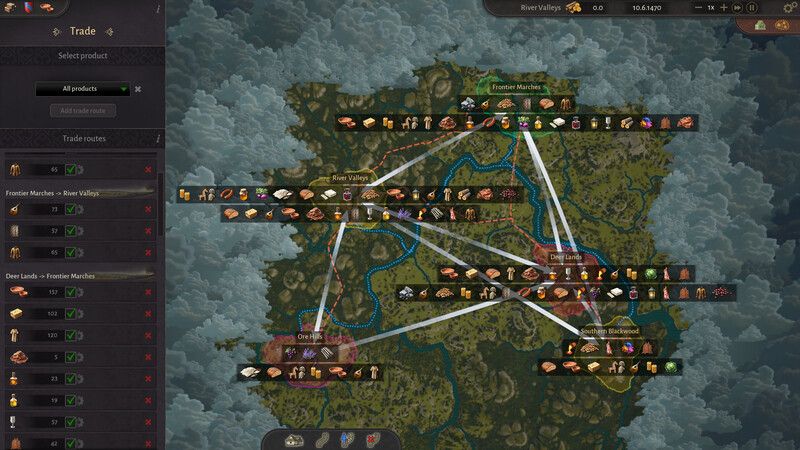
When an ingredient must come from another region, local road-connected distribution is only part of the eventual supply relationship. The exporting region, receiving region and selected product need to be considered through the inter-region trade system described in the FAQ. Identify the particular good you need to import before assuming that an existing route for another product also resolves this settlement's missing meal ingredient.
The trade routes guide explains the Trade interface, supporting infrastructure and demo transport distinctions. Use that page when the source lies outside the receiving region, while keeping the food recipe as the reason for investigating the route. This avoids confusing a valid connection for one product with proof that every ingredient needed by the destination has already been delivered.
Reassess needs after settlement progression
The collected research recommends reviewing demand after upgrades because settlement growth and consumption needs are connected. Return to the current settlement panel when the county changes instead of assuming that the supply arrangement that served an earlier stage still explains every present requirement. The useful comparison is between the needs now displayed and the producers and connections intended to satisfy them.
Keep an upgrade problem separate from the food problem that may be contributing to it. The settlement upgrades guide distinguishes unmet food and equipment needs, additional building slots and the demo's progression limit. That distinction prevents you from treating every unavailable upgrade as a reason to produce more of one food, even when equipment or the version cap is the relevant blocker.
Check the whole recipe before changing it
A recipe with one supplied ingredient can still lack another ingredient needed for its benefit. Before changing the meal selection, identify what is actually missing and whether the existing production network was intended to provide it. That gives the change a clear purpose, instead of making repeated selections without understanding which goods each option asks the county to deliver.
If you decide to organize supply around a different selected meal, repeat the ingredient-by-ingredient check for that selection. A successful delivery of one product does not establish that another recipe's full set of ingredients is available to the same settlement. The principle remains the same throughout: read the actual requirement, locate the relevant supply and verify the connection to the consumer before concluding that food production in general is sufficient.
Avoid turning one player's shortage into a universal rule
The collected player discussion describes the need to rebalance food across regions in an older demo. It is useful context for why regional supply deserves attention, but it does not establish a universal recipe or prove that every current shortage has the same cause. The official meal and distribution explanations provide the firmer basis for the checks on this page, so use the older report as context rather than as a guaranteed fix.
Do not add an explanation involving spoilage, seasonal consumption or a fixed production ratio unless the current game's information actually establishes that mechanic. Those details were not verified by the research supplied for this food-shortage question. You can make the diagnosis specific without them by distinguishing an absent ingredient, an interrupted connection and a receiving settlement whose current needs deserve another look.
Use a short supply-first troubleshooting loop
Start with the selected meal, identify each ingredient, inspect its producer and stock, then check the local connection or inter-region route that should deliver it. After addressing the missing relationship, return to the settlement and compare its displayed needs with the supply you have just investigated. This is an editorial troubleshooting sequence built from the documented systems, not a promise that every shortage disappears after one identical adjustment.
Once the food issue is understood, connect the result to the rest of the county's opening plan. The beginner guide places food alongside logging, carpentry and equipment, because those systems support different parts of early development. Keeping the original recipe visible through the investigation gives you a clearer answer than expanding all of those systems at once and losing track of which change was meant to solve the shortage.
Official sources
Information checked November 4, 2026. Send a correction.