
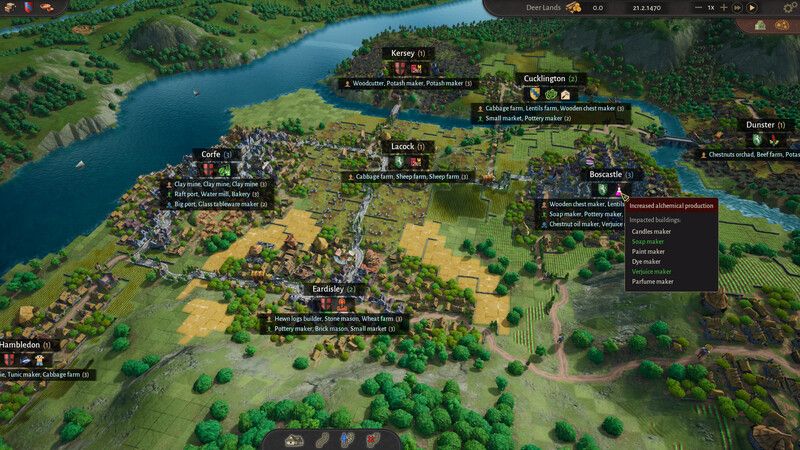
Decide which kind of delivery you need
A settlement receiving goods from another settlement in its own region is not the same problem as importing from a different region. The official FAQ describes local distribution through road-connected settlements after a food recipe or equipment need is selected. Inter-region trading instead uses the Trade interface and supporting market or port infrastructure, so adding a route is not the starting action for every delivery problem.
Begin by identifying the producer's region and the receiving settlement's region before changing transport infrastructure. If both are in the same region, inspect local connections and the need that should attract the delivery. If they are in different regions, follow the inter-region setup and check the movement restrictions for the good involved, rather than expecting an ordinary road connection to answer every part of the problem.
Establish the relevant trading infrastructure
The researched setup for inter-region trade begins with access to level-two markets or raft ports. This requirement links regional trade to settlement progression, rather than making the Trade screen an independent substitute for the buildings supporting movement. When you cannot establish the expected route, check the region's available infrastructure before assuming that selecting another product in the menu will remove the obstacle.
Use the settlement upgrades guide if reaching the necessary settlement stage is the part that is blocked. Food and equipment needs control progression, while equipment also affects building space, making those distinctions useful before committing to a trading plan. Once the relevant infrastructure is available, return to the specific product and the regions that need to exchange it.
Open Trade and choose the good
The official FAQ identifies T as the shortcut for opening Trade. Start with the product you want to move, because the product's identity determines which producer and receiving region belong in the route you are creating. A route for a different good cannot establish that the missing material is being supplied, even if the same two regions already exchange something else successfully.
After choosing the good, identify the source and destination and add the route between those regions. The updated FAQ also describes auto-trade behavior, so read the route's current settings rather than assuming the menu entry alone explains every future delivery. Keep the original supply question visible throughout setup: which region has the good, which region needs it, and what connection is meant to carry it between them.
Account for downstream movement in the demo
Demo rafts travel downstream, which makes the direction of the river part of trade planning rather than a cosmetic detail of the map. A producing region and a receiving region can both have river access without the demo allowing the required movement in your intended direction. Inspect direction before treating the presence of two ports as proof that a particular supply relationship is possible.
This matters when the receiving region depends on a resource that is available elsewhere along the river. If the required delivery would run upstream, adding another copy of the same downstream-only arrangement does not establish a valid solution. The Early Access information announces ports and sailboats capable of travel in both directions, but that announced behavior should not be substituted for the demo rule when troubleshooting a demo save.
Match heavy goods to river transport
The official FAQ distinguishes heavy goods that require river transport between regions. Stone is a practical example because it can be needed as input to a mason's guild, making an unavailable delivery visible as a construction problem farther along the chain. Check the material's transport requirement before assuming that a connected road between regions is sufficient for every product you want to import.
Keep the scope of this restriction precise when reading a stalled route. The researched river-only rule concerns inter-region transport, not a claim that stone can never move locally through any road-connected settlement. The stone guide separates quarry production, delivery and masonry processing so that a transport problem does not get confused with a missing producer or a guild that lacks its input.
Check supply before blaming the route
A route describes where a product should move, but its existence does not prove that the exporting region is supplying the product you selected. Follow the good back to its producer and inspect whether the chain feeding that producer is working. This is particularly useful when the missing import is a finished good whose workshop depends on another material before there is anything to deliver.
The same check applies at the receiving end, where the settlement's actual need helps identify which product matters. Compare the good selected in Trade with the input or consumption need that first drew your attention to the missing delivery. The production chains guide follows that connection from input through processing to consumer, providing a more focused question than whether trade in general appears to be working.
Diagnose local distribution separately
For deliveries inside one region, inspect the road connection between producing and consuming settlements and the selected food or equipment need. The updated FAQ explains that connected settlements distribute goods automatically in response to those needs, making the consumer's configuration part of the delivery check. An unrelated inter-region route does not answer whether the local settlement has selected and can receive the good it is supposed to consume.
If the symptom is a missing meal, follow every ingredient rather than checking only one food producer. A settlement can have access to one product while another ingredient required by its selected recipe is still missing from the local supply. The food shortage guide uses that distinction to separate absent ingredients, stock that is not arriving and demands that deserve another look after settlement progression.
Keep a route checklist tied to one product
A useful route review records the good, its source region, its receiving region, the supporting infrastructure and the direction of travel. Add the relevant material restriction and the current version before deciding what needs to change in the county. This sequence is a diagnostic aid assembled from the official rules, rather than a guarantee that every missing delivery is caused by one of the same mistakes.
Use the written October FAQ as the main reference when a historical screenshot or older guide seems to describe something different. The earlier trading preview establishes the county-level idea, but a preview image does not supply a complete throughput rule or prove a specific route's capacity. Once the product and connection are clear, check its role in construction or settlement growth to confirm that the original bottleneck is actually being addressed.
Official sources
Information checked November 4, 2026. Send a correction.